
Houston turf service
Turf Base Preparation and Grading in Houston, TX
The performance difference between a synthetic grass installation that holds for fifteen years and one that develops drainage problems in three comes down to base preparation. Artificial Turf of Houston builds bases for Houston's clay soils and rainfall volumes — not generic specifications from somewhere else.
Service Overview
Base Preparation Built for Houston's Outer-Loop Soil Conditions
The Beltway 8 corridor sits largely on Houston's expansive black clay — the same material that shifts under slabs, causes foundation movement, and holds water far longer than sandy soils after rain. Building a turf sub-base on Houston clay requires engineering decisions specific to these conditions: excavation depth, aggregate selection, compaction standard, and grade design all need to account for the fact that the native soil below is not cooperating with water movement the way soil in other regions might.
Artificial Turf of Houston's base preparation work addresses these site-specific factors before installation begins. We assess the drainage patterns of the specific lot, design the grade to move water effectively, select aggregate appropriate for the use intensity and drainage demand, and compact to specifications that resist the seasonal expansion and contraction Houston clay puts base systems through. This isn't a single formula applied everywhere — it's site work that matches the property.
We offer base preparation as a standalone service for property owners who have purchased turf materials elsewhere or are working with a contractor who needs a prepared sub-base. We also build the base as part of our full-service turf installations. In either case, the approach is the same: assess the site, design the base for the actual conditions, build it correctly, and document what was done.
Benefits
Why Correct Base Preparation Matters on the Outer Loop
Drainage That Handles Houston Rain
A 3-inch spring storm on a clay lot in Greenspoint or Alief needs a base system designed for that volume. Generic base depths built for sandy soils or low-rainfall climates don't move water adequately on Houston clay. We design drainage for the actual rainfall intensity this corridor experiences.
Resists Houston Clay Movement
Houston's black clay expands when wet and contracts when dry — a seasonal cycle that shifts and undermines bases that weren't built to handle it. Proper aggregate depth and compaction create a base layer that resists this movement and keeps the turf surface flat over time.
Prevents Surface Failure
The most common artificial turf failures — bubbling, seam lifting, surface undulation — trace back to base problems. A correctly prepared base prevents these failure modes from developing regardless of surface turf quality.
Supports Any Use Intensity
A pet zone with two large dogs puts very different load demands on a base than a front yard used primarily for appearance. We design base depth and compaction to match the actual load the surface will carry.
Protects Foundation Drainage
Residential base preparation must grade water away from the house foundation. Misgraded bases that direct water toward a slab are a real liability. We check and design for foundation drainage specifically on every residential base project.
Long Warranty Coverage
Turf manufacturer warranties require proper base preparation. A documented base system built to manufacturer specifications supports the full warranty period instead of creating grounds for warranty denial when problems develop.
Process
Base Preparation and Grading Process
Site Drainage Assessment
We evaluate how water currently moves across the lot, where it concentrates, what the drainage outlets are, and how the clay soil profile affects infiltration. This assessment drives the base design — specifically depth, grade angles, and whether French drain integration is needed.
Excavation
We remove existing vegetation, soil, and organic material to the depth required for the base design. Houston clay lots often require deeper excavation than sandy-soil markets to achieve adequate drainage performance. We remove what the design requires, not what's expedient.
Native Soil Preparation
Exposed clay subgrade is assessed and prepared. Problem areas with standing water, soft spots, or soil instability are addressed at this stage rather than buried under aggregate and discovered later.
Aggregate Installation and Grading
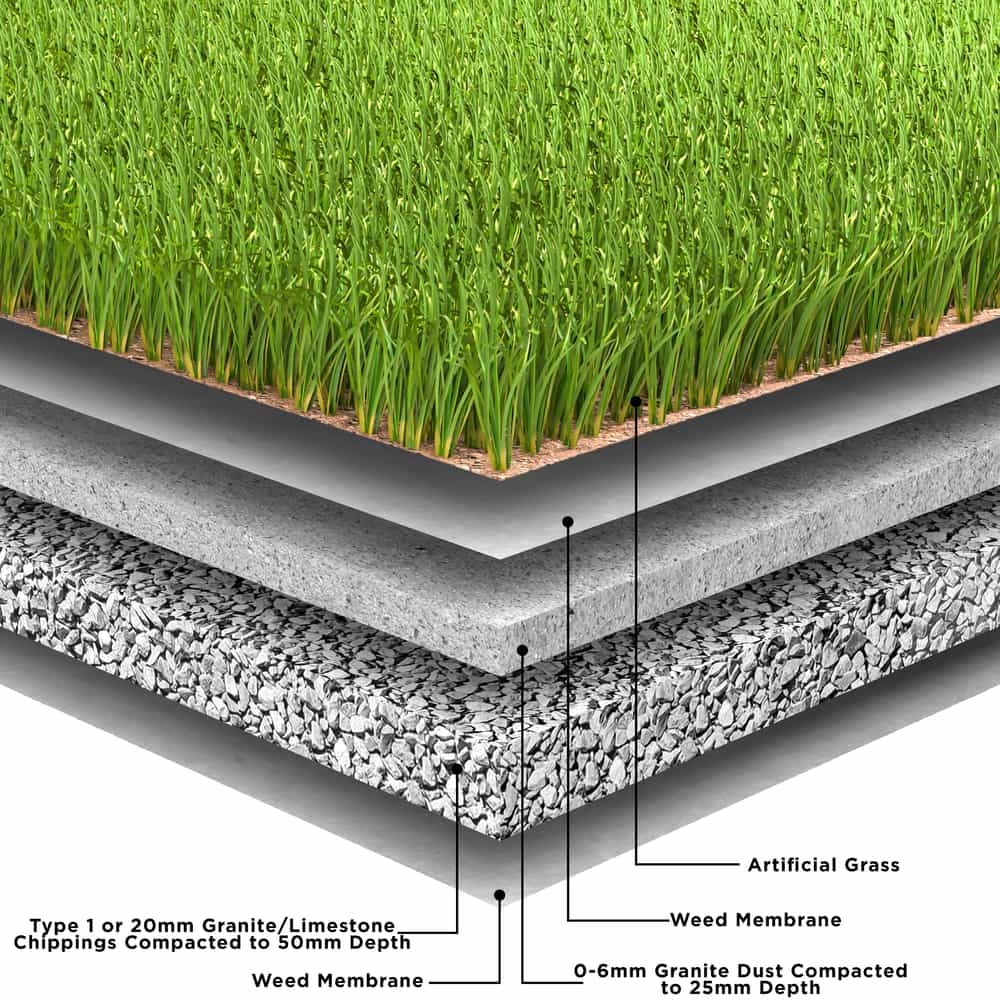
Crushed limestone or decomposed granite aggregate is placed in layers, each graded at the appropriate pitch for drainage. We establish all drainage slopes at this stage — the finished grade is set here, not after the turf is installed.
Compaction and Final Check
Aggregate is mechanically compacted to specification across the entire base area. We inspect grade, verify drainage pitch, and confirm compaction quality before calling the base ready for turf.
Applications
Base Preparation Applications
New Residential Backyard Installations
Full base preparation for backyard turf projects across Alief, Sharpstown, Bear Creek, and the outer-loop residential corridor — the foundation of every backyard conversion we install.
Front Yard Installations with Foundation Grade
Front yard base work with specific attention to maintaining proper drainage away from the house foundation — a requirement on every residential front yard project.
Replacement Base Correction
Regrading and improving existing base systems under turf replacement projects where original drainage design contributed to system failure.
Commercial Landscape Strips
Base preparation for commercial properties along US 290, Highway 59, and the Westchase corridor — designed for commercial foot traffic loads and municipal drainage requirements.
Sports Field Sub-Base
Engineered sub-base construction for school and community athletic facility turf projects across Cy-Fair, Klein, and Spring Branch ISD campuses.
Standalone Base Services
Base preparation for contractors, homeowners, or property managers who have sourced turf separately and need a properly built sub-base to install over.
Why This Site Frames It This Way
Why Artificial Turf of Houston for Base Work
Houston Clay Expertise
Building on expansive black clay requires different decisions than building on sandy or loamy soil. We understand how Houston's soil behaves through the wet-dry cycle and design base systems that account for it.
Drainage Design Before Excavation Starts
We design the drainage grade before the first shovel hits the ground. Base drainage is not something we figure out after excavation — it's the plan the excavation executes.
Correct Excavation Depth
Shallow excavation is one of the most common cost-cutting shortcuts in turf installation. We excavate to the depth the design requires, not the minimum needed to get turf laid.
Foundation Safety on Every Residential Job
On every residential installation, we verify that the base grade moves water away from the foundation. This is checked explicitly, not assumed.
Documented Work
We provide documentation of base specifications — depth, materials, grade, and compaction approach — to support manufacturer warranty coverage and property records.
FAQ
Base Preparation Questions
How deep does the base need to be on Houston clay?
Most Houston residential installations require four to six inches of compacted aggregate. Heavy-use commercial or sports applications may need more. Clay lots with significant drainage challenges may need additional depth and French drain integration versus what a sandy-soil site requires. We determine the right depth at the site assessment.
What aggregate do you use in Houston base systems?
We primarily use crushed limestone, which is readily available in Houston and compacts well while maintaining permeability. Decomposed granite is used in some applications. Material selection depends on the drainage requirements and load demands of the specific project.
Does every installation need a French drain?
Not necessarily, but more Houston outer-loop installations benefit from French drain integration than installations in other markets because of the clay soil. Low-lying lots, lots with chronic drainage problems, or installations near foundation edges often need more than a graded aggregate base. We assess this specifically at the site visit.
Can you fix drainage problems in an existing installation without full removal?
Minor drainage issues — slow-draining areas with adequate base otherwise — can sometimes be addressed without full removal through edge drainage additions. Significant base drainage failure usually requires turf removal, base correction, and reinstallation. We assess the situation and give an honest recommendation.
Will the base hold up through Houston flooding events?
A properly compacted limestone aggregate base is resistant to flooding damage. The base doesn't wash out or shift in typical storm events. For lots in known flood zones, we design drainage to move flood water away from the turf area rather than expecting the base to absorb it.
How long does base preparation take?
Residential base preparation typically runs one to two days. Larger commercial projects or installations requiring French drain integration take longer. We build realistic timelines into the project proposal.
Service Areas
Turf Base Preparation and Grading is routed through Houston and the surrounding local pages.
The service template stays tied to the Houston route stack, so supporting city pages and service pages reinforce each other instead of standing alone.
Need a quote for this service?
Build the Foundation for a Lasting Installation
Artificial Turf of Houston prepares turf bases across the outer-loop corridor. Whether part of a full installation or a standalone service, we build bases for Houston's actual soil and rainfall conditions. Send us the project details.